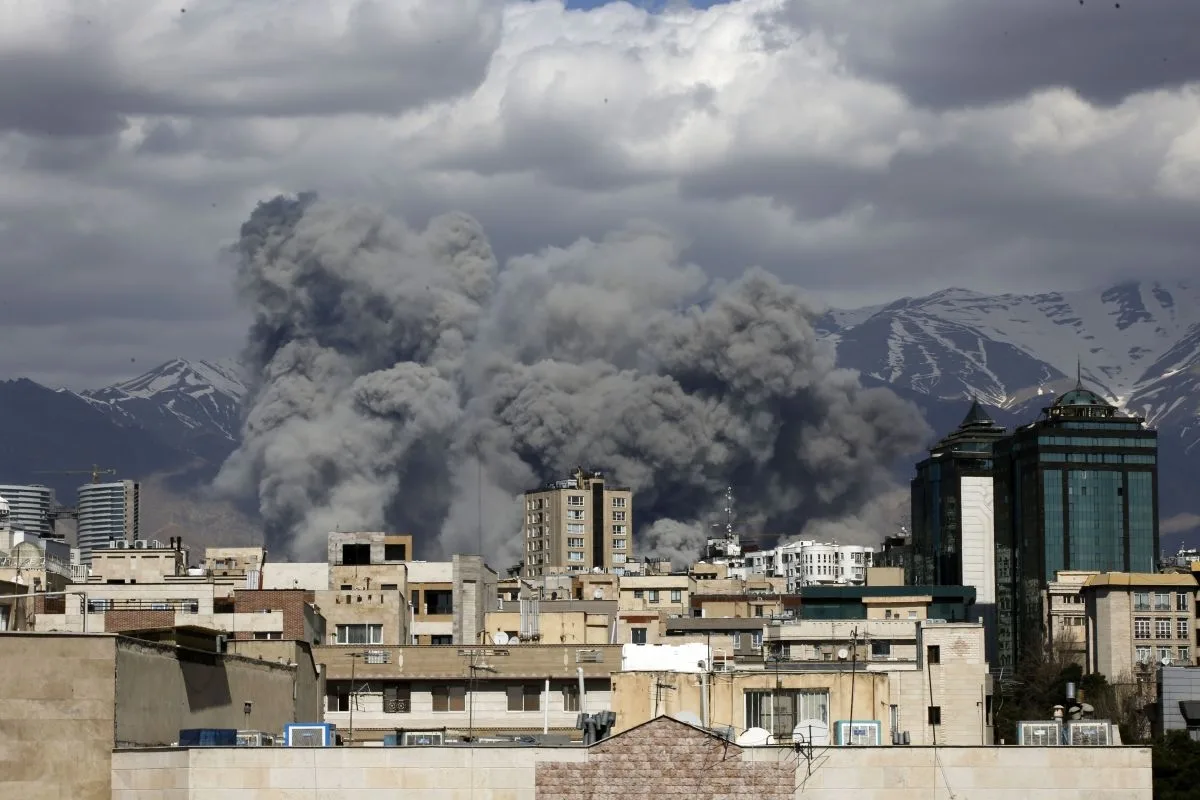
Rodrigo Amaral, a professor of International Relations at PUC-SP, explains the real interests behind the conflict and does not currently see any imminent risk of a “third world war.”
In the early hours of last Friday (February 28), a coordinated airstrike led by the military command of the United States and Israel hit Tehran, the capital of Iran, leaving more than 200 dead.
Illuminated by bombs and aircraft, Tehran’s sky signaled the beginning of what the country would soon face: another episode in the horrors of war spreading across the Middle East, especially since Israel’s initial attacks on Palestine.
The main targets, according to the justification presented by both countries, were the Command and Control Center of the Islamic Revolutionary Guard Corps and the bunker where Supreme Leader Ali Khamenei was located—the ayatollah’s death was confirmed hours later.
The offensive led by Donald Trump and Benjamin Netanyahu, in addition to resulting in the deaths of hundreds of children, was officially justified as “preventive self-defense” and based on Iran’s alleged nuclear capabilities. However, for Rodrigo Amaral, this is yet another fallacy of American liberalism. “What Trump is doing could be described as a form of ‘open imperialism,’ in which he openly demonstrates an immediate desire to overthrow the Islamic regime in order to project power and, consequently, gain access to Iran’s natural resources,” he explains.
Iran is one of the world’s largest oil producers, with an estimated production of around 3.3 million barrels per day (bpd) in 2026, according to data from the Organization of the Petroleum Exporting Countries (OPEC). This represents about 12% of global reserves, with China as its main destination. “In addition, the country is strategically important from a geopolitical standpoint, as it connects Asia to Europe and includes the Strait of Hormuz, through which more than 30% of the world’s oil passes. In other words, controlling Iran is the real ambition behind this conflict.”
The expert also points out that armed conflict is not the only way the United States imposes itself on political adversaries. “Imperialism is not limited to missile attacks. Economic sanctions against Iran, for example, have been in place for decades. That is why the U.S. is now intensifying Iran’s isolation, including through threats to its trade partners.”
Third World War?
Immediately after the first images of the conflict were released, social media analytics platforms such as Santiment and Google Trends showed a sharp increase in searches for the term “third world war.” Whether through memes or supposedly “technical” posts, the idea of a global conflict quickly dominated online discussions.
Amaral, however, is categorical in stating that there is no concrete evidence of other nations becoming involved—especially China and Russia. “The use of the term ‘third world war’ is indeed alarmist. There is nothing indicating a truly global involvement. At worst, this is likely to remain a regional conflict involving Iran’s neighbors. I do not believe we are facing a third world war at this moment. The expression dates back to the Cold War and would imply the use of nuclear weapons. It is important to note that Iran does not have military nuclear capability, and there is no indication of involvement from Russia or China, which are counter-hegemonic actors to the West.”
Domestic issues
Beyond alarmism about a possible global conflict, there is a growing perception that Trump’s decision to initiate a new war serves as a distraction from internal crises in the United States. Factors such as persistent inflation, geopolitical pressures affecting energy prices, immigration crackdowns, and labor market uncertainty have created a tense economic environment.
Part of the public response has been clear. “On one hand, we have a military action that shifts media attention toward war and away from domestic issues that Trump has been facing, such as accusations of human rights violations against immigrants or people of Latin descent, as well as corruption allegations dating back to his first term. So, the context of crisis may be intensifying external actions, and this has been quite evident in his second administration.”
Amaral also notes that, beyond the current conflict, Trump has implemented actions such as the alleged “abduction” of Venezuelan president Nicolás Maduro, unconditional support for Israel in opposition to Palestine, and repeated suggestions of annexing Greenland, an autonomous territory belonging to Denmark. “All these actions demonstrate a desire to assert hegemonic power by force, but they also reveal clear contradictions in terms of legitimacy.”
Is Brazil at risk?
Donald Trump’s foreign policy has already put Brazilian sovereignty at risk with the so-called “tariff hike,” which proposed increases of up to 50% on Brazilian products. The reversal came after a combination of diplomatic negotiations—led by President Lula—legal actions, and ultimately a decision by the U.S. Supreme Court declaring the tariffs illegal.
Economic threats have not been entirely ruled out, but they are unlikely to result in any military intervention. “I do not believe that is possible, although economic interventions may still occur. What could happen is a stronger stance from Trump’s administration due to the connection between Brazilian elites and its own interests.”