



Sobre a FPA
Sobre a FPA
History
The Perseu Abramo Foundation was established by the Workers’ Party (PT) by decision of its National Directorate on May 5, 1996. This decision paved the way for the realization of a long-standing aspiration of the PT, which was to create a space, outside of party structures, for the development of activities such as political and ideological reflection, the promotion of debates, studies, and research, with the breadth and plurality of opinions that are rarely found in the day-to-day struggles of a political party. An experience in creating an institution of this nature had already been attempted: the Wilson Pinheiro Foundation, which functioned for some time, supported by the participation of some of the most prominent intellectuals and leaders of the Party, but eventually collapsed for various reasons, including the instability of financial resources.
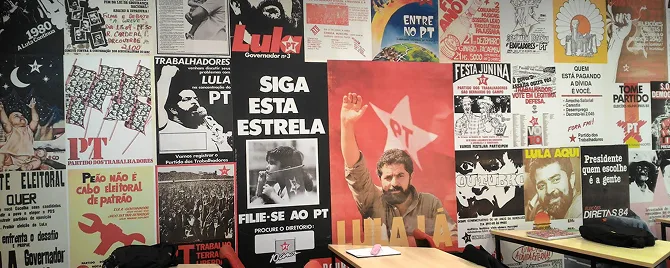
The Wilson Pinheiro Foundation no longer exists, but the idea that inspired it never died within the party; on the contrary, it matured based on previous experience and became a firm conviction of the National Directorate. The viability of the project received a major boost with the guarantee of a permanent financial base, provided by the creation of the Party Fund. This fund was established by article 38 of the Law of Political Parties (Law 9.096 of September 19, 1995); the same law also stipulated, in item IV of its article 44, that at least 20% of the funds allocated to parties under this title should be applied to the creation and maintenance of an institute or foundation for research, indoctrination, and political education.
At that time (late 1995 and early 1996), Perseu Abramo, who had assumed the role of National Secretary for Political Training, began developing studies for the establishment of the future institute or foundation, consulting on the advantages and disadvantages of each of these models, preparing some basic documents on the subject, and even formulating a preliminary project outlining the institution’s lines of work. Perseu dedicated a large part of his efforts, in the last months of his life, to this work.
The next step began with the decision of the National Board, which opted for the creation of a foundation. The choice of this model – given that foundations are audited and must report to the Public Prosecutor’s Office through the Foundations Curatorship – was deliberate, to guarantee the rigor and transparency of all actions to be carried out by the institution. Having made this choice, a small group of people who had followed the previous discussions was tasked by the National Board with continuing – based on the ideas already outlined by Perseu – the preliminary studies to define the legal basis, objectives, and program of activities of the new foundation.
The two documents prepared for this purpose: one defining the “Elements for a work plan” and the other containing the Foundation’s statutes, were unanimously approved at the DN meeting on 5/5/96.
The following definitions were thus established:
The Foundation’s nature, as a private law institution established by the Workers’ Party but with legal and administrative autonomy, headquartered in São Paulo but with a national scope, “has as its purposes research, doctrinal development, and contributing to the political education of members of the Workers’ Party and the Brazilian working people.”
The constituent bodies of the Foundation:
I. The Board of Trustees, composed of 21 members to be appointed by the National Board, is responsible not only for the tasks of oversight, approval of accounts, budget and annual work plan, but also for decisions on all important matters such as those relating to any changes to the statutes or assets of the institution, and more than that, for discussing the general lines of work and contributing to the development of the Foundation’s activities through critical evaluation of ongoing projects and suggestions for new initiatives. Quarterly ordinary meetings are scheduled to fulfill these responsibilities.
II. The Executive Board, composed of six members: a president, a vice-president, and four other directors, with responsibilities for planning, guiding, and coordinating the Foundation’s work, representing the entity externally, including before the Foundations Curatorship, and liaising with party bodies and various segments of society in general.
At the same meeting, the names for the first board of trustees were chosen, based on representativeness criteria that took into account the following factors: the plurality of positions and opinions within the party; regional diversification; the professional and field of activity diversity necessary for the proper execution of the tasks assigned to the Board; and significant participation of women.
The general outlines of the work plan included the following areas of activity:
– Recovery of the memory and history of the PT (Memory and History Project)
– Ideological, political and cultural reflection (Reflection)
– Socialization of accumulated political-ideological-cultural heritage through events, publications, and political education (Theory and Debate Publishing House and Magazine)
– Public opinion research (Public Opinion Center)
The board of directors and the board of trustees immediately began to carry out their duties, developing preliminary tasks such as those inherent to the legal registration of the foundation, the selection and renovation of the temporary headquarters and the purchase of the permanent headquarters, the selection and hiring of the first employees, and the acquisition of the minimum furniture and equipment necessary to begin operations.
Finally, with the Foundation’s situation now regularized, on October 14, 1996, the board of trustees and the directors took office simultaneously, and on the 19th of the same month, the provisional headquarters of the Perseu Abramo Foundation was inaugurated. In November of the same year, the FPA’s first public activity was held: the seminar “The Petista Way of Governing – 3rd Generation”.
Click here to learn a little about Perseu Abramo.
Executive Board
Brenno César Gomes de Almeida
Interim President
Elen Coutinho
Director
Mônica Valente
Director
Naiara Torres
Director
Alberto Cantalice
Director
Alexandre Macedo de Oliveira
Director
Carlos Henrique Árabe
Director
Jorge Bittar
Director
Valter Pomar
Director
Board of Trustees
Eleonora Menicucci (president), Ademar Arthur Chioro dos Reis, Ademário Souza Costa, Ana Carolina Dartora, Ana Maria de Carvalho Fontenele, Azilton Ferreira Viana, Eliane Aquino Custódio, Elisa Guaraná de Castro, Esther Bemerguy de Albuquerque, Eva Valéria Lorenzatto, Everaldo de Oliveira Andrade, Fernando Damata Pimentel, Fernando Dantas Ferro, Francisco Ferreira Alexandre, Francisco José Pinheiro, Helena Wendel Abramo, José Zunga Alves de Lima, Juarez Rocha Guimarães, Lene Teixeira Souza Gonçalves, Luciano Cartuxo Pires de Sá, Luiza Machado de Oliveira Menezes, Maria Caramez Carlotto, Maria Isolda Dantas de Moura, Neiva Ribeiro, Pedro Silva Barros, Ramatis Jacino, Rubens Natal Giaquinto, Sergio Aparecido Nobre and Vladimir de Paula Brito.
Contact us
Please contact us by email at [email protected]
