The world of work in the Amazon region, viewed from the perspective of sustainability and climate change challenges, is one of the themes that will permeate the discussions.
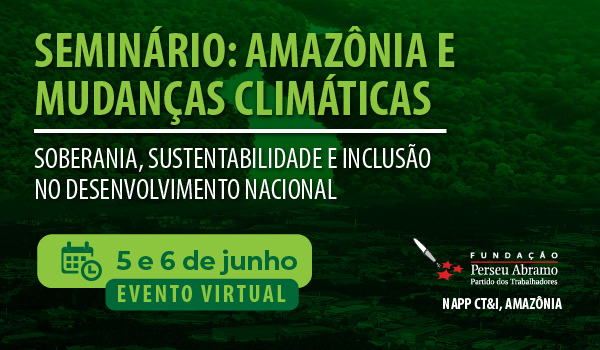
On June 5th and 6th, the Perseu Abramo Foundation will host the “Seminar: Amazon and Climate Change – Sovereignty, Sustainability and Inclusion in National Development” to discuss sovereignty, sustainability and inclusion in national development.
With seven virtual lectures, broadcast live on the FPA’s YouTube channel in the morning and afternoon, the event promotes meetings between researchers, professors, local leaders, social movements, and other stakeholders. It is organized by the Center for Monitoring Public Policies – Science, Technology and Information (NAPP CT&I) of the foundation and aims to formulate proposals to be presented to members of parliament from the Workers’ Party and also at COP30.
According to the seminar’s program, the idea is to raise the debate on strategies for building a national policy for sustainable development in the Amazon, considering the urgent priorities highlighted by the IPCC (Intergovernmental Panel on Climate Change) and the recommendations of Brazilian scientists on biodiversity.
Furthermore, the lectures aim to explore strategic international partnerships that strengthen Brazil’s autonomy and sovereignty on the global stage, and also to discuss the prospects for the world of work and the main priorities that will be on the COP30 agenda, which will be held in Belém, Pará, in November of this year.
“The debate on the sustainable use of natural resources in the Amazon is still very insufficient, despite the climate emergency and the importance of the region for climate stability in Brazil and the world,” says Esther Bemerguy, one of the coordinators and organizers of the event.
According to the economist, “the extractive model, which has been in place for decades, deforests, degrades, and does not bring development to the region. This is proven by various social indicators in the Amazon, whether related to education, health, housing, employment, or income,” she says.
Climate change, governance and sustainable development in the Legal Amazon.
According to the latest IBGE census, the population of the Legal Amazon, which includes part of Maranhão and the states of Acre, Amazonas, Amapá, Pará, Rondônia, Tocantins, and Mato Grosso, is around 28 million inhabitants.
In a comparison of the Northern region with the absolute number of the country, the population growth in the last decade is highlighted. While the North grew 0.75% per year, the Brazilian expansion rate is 0.52%. According to MapBiomas, in the Legal Amazon, forest cover comprises 75% of the area, agriculture 17%, non-forest natural formations 5%, and water bodies 2%. From 1985 to 2019, more than 721,000 km² of forest areas underwent transition to agriculture.
According to Bemerguy, work in the Amazon region is marked by strong informality, with more than 50% of workers outside the formal market. “The work we want there must be work that is capable of reproducing and conserving the forest ecosystem and the culture of traditional peoples. It is necessary to encourage extractivism, artisanal fishing, family farming in settlements, indigenous communities, and quilombola communities,” argues the economist.
To address regional complexity, the thematic areas covered in the panels will be: 1) Sustainable Territorial Development; 2) Climate Change and Biodiversity; 3) Governance and International Commitments; 4) Science and Technology, Training and Inclusion; 5) Bioeconomy and Alternative Development Models; 6) Labor and Social Justice in the Amazon; 7) Pan-Amazonian Integration and Border Development.
In this sense, according to the organization, the seminar will also address the negative impacts of the current predatory model and the possibilities of transitioning to a sustainable development model that opens up new opportunities for quality jobs in strategic sectors such as: bioeconomy, renewable energies, reforestation, environmental monitoring and ecotourism.
“For this transition to be fair and inclusive, it is essential to invest in the professional training of the Amazonian population, ensuring that workers have access to technical and scientific training geared towards the new demands of the sustainable market,” states the event’s promotional document.
Check out the program for the seminar “Amazon and Climate Change – Sovereignty, Sustainability and Inclusion in National Development”:
June 5th
8:30 AM – Opening Session
With Paulo Okamoto (President of the Perseu Abramo Foundation), Airton Faleiro (Federal Deputy, PT/PA), Luiz Antonio Elias (Coordinator of NAPP CT&I), and Pedro Silva Barros (FPA)
9:30 AM to 11:00 AM – Theme: Sustainable Territorial Development
Lecture: Infrastructure and Sustainable Development in the Amazon
Panel: “Territory, Infrastructure and Sustainability: Paths to a New Amazonian Model”
Speakers: Ana Claudia Cardoso (UFPA), Alcineide Piratapuya (UNB), Bruno Malheiros (UNIFESSPA) / Moderator: Esther Bemerguy de Albuquerque (FPA)
11:00 AM to 12:30 PM – Theme: Climate Change and Biodiversity
Lecture: Biodiversity and Green Economy – Opportunities and Challenges
Panel: “Climate Change and Biological Richness: Strategies for Preservation and Sustainable Use”
Speakers: Henrique Pereira (IPAM) and Gilberto Câmara (INPE), Pedro Paulo Zahluth (Unicamp) / Moderator: Adriana Abdenur (Co-President of the Global Fund for a New Economy (GFNE). Between 2023 and 2025, she was Special Advisor on International Relations in President Lula’s office. She is a co-founder of the CIPÓ Platform)
2 PM to 3:30 PM – Theme: Governance and International Commitments
Lecture: The Amazon in Global Geopolitics – the role of the Pan-Amazon region and the Challenges and Proposals for COP30
Panel: “Governance and Sovereignty: Brazil’s Role in the International Climate Agenda”
Speakers: Marilene Corrêa (UFAM), Dilvanda Faro (Federal Deputy, PT/PA), Luiz Marques (UNICAMP)
3:30 PM to 5:00 PM – Theme 4: Science and Technology, Training and Inclusion
Lecture: Research and Innovation Network for the Amazon
Thematic Panel: “Science, Technology and Education: Basis for Sustainable and Inclusive Development”
Speakers: Tanara Lauschner – UFAM, Fábio Guedes FAPEAL/ICTPbr, Raimunda Monteiro (UFPA), Nilson Gabas (MPEG) / Moderator: Ildeu Moreira (UFRJ)
June 6th
9:00 AM to 10:30 AM – Theme 5: Bioeconomy and Alternative Development Models
Lecture: Bioeconomy and Inclusive Development Models in the Amazon
Thematic Panel: “Bioeconomy and Productive Inclusion: Alternatives to Predatory Extractivism”
Speakers: Tanara Lauschner (UFAM), Tatiana Sá (EMBRAPA); Márcio Meira (BNDES) / Moderator: Ima Vieira (MPEG)
10:45 AM to 12:15 PM – Theme 6: Work and Social Justice in the Amazon
Lecture: Just Transition and Decent Work in the Amazon Region
Thematic Panel: “The Future of Work in the Amazon: Challenges and Opportunities”
Speakers: Clemente Ganz (CDESS), Dione Torquato (CNS) / Moderator: Luiz Antonio Elias (Napp CT&I)
2:00 PM to 3:30 PM – Theme 7: Pan-Amazonian Integration and Border Development
Lecture: Regional Integration, International Cooperation, and Sovereignty on the Amazonian Borders
Speakers: Vanessa Grazziotin (Director of OTCA), Rosalia Arteaga (former President of Ecuador), Jorge Audy (PUCRS) / Moderator: Pedro Silva Barros FPA
4 PM – Closing: Seminar Summary
Paulo Okamoto FPA, Luiz Antonio Elias (NAPP/FPA) and Pedro Silva Barros